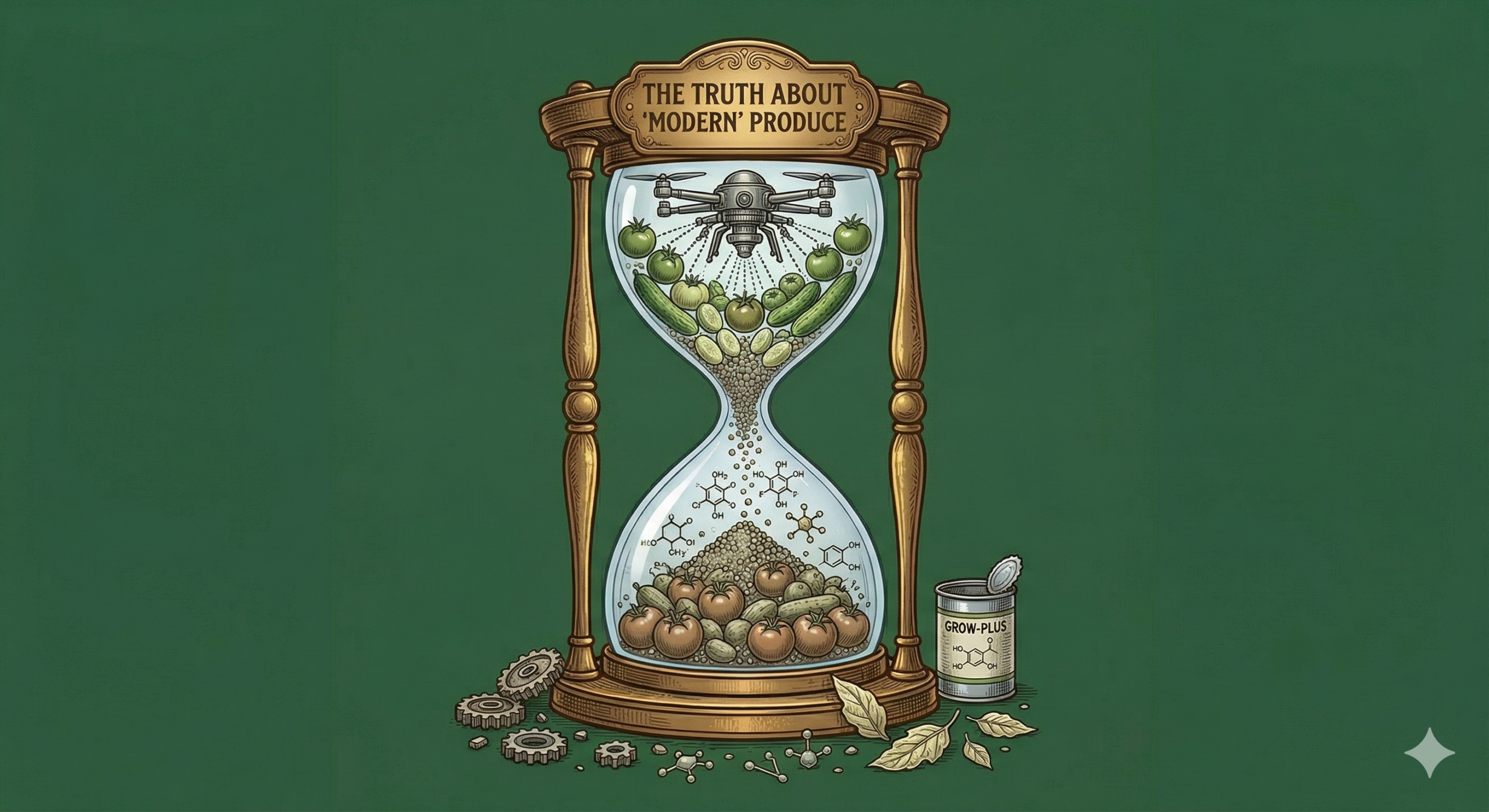
The story of modern produce is a tale of two very different paths: one optimized for the ledger, and the other optimized for the cell.
Here is the summary of why the “perfect” grocery store vegetable is often a biological illusion, and how a different approach restores that lost value.
The Industrial Mirage
In a typical grocery store, produce is designed to be a commodity. To make it affordable and available year-round, industrial agriculture has optimized for three specific metrics: Size, Shipping, and Shelf-life. * The Dilution Effect: By force-feeding plants synthetic NPK (Nitrogen, Phosphorus, Potassium) fertilizers, we make them grow faster and larger than ever before. However, the plant’s ability to pull trace minerals from the soil cannot keep up with this rapid growth. The result is “diluted” nutrition—you get a bigger tomato, but it contains significantly less Copper, Iron, and Magnesium than it did 50 years ago.
- Genetic Trade-offs: Industrial seeds are selected for thick skins (to survive 2,000-mile truck rides) and uniform ripening. Unfortunately, the genes responsible for flavor and nutrient density are often linked; when you breed for “toughness,” you inadvertently breed out the complex phytonutrients that give food its medicinal value.
The Biological Engine
The alternative path treats the farm as a living laboratory rather than a factory. This approach focuses on the “Biological Engine” of the soil.
- Soil as a Service: Instead of sterile dirt, healthy soil is a thriving ecosystem of fungi and bacteria. These microorganisms act as the “gut” of the plant, predigesting minerals and making them bioavailable. At Nomad Prairie Farms, we don’t just grow plants; we manage the biology that feeds them.
- Heritage Resilience: By using heirloom and heritage genetics—like the Crested Cream Legbar or traditional prairie brassicas—we tap into thousands of years of evolutionary wisdom. These breeds haven’t had their “health genes” bred out of them; they are naturally more nutrient-dense because they were designed to thrive, not just to travel.
The Race Against Oxidation
The final part of the story is the physics of time. Nutrition has a half-life. The moment a plant is cut from its life source, enzymes begin to break down and oxidation sets in.
- The 48-Hour Rule: Most grocery store produce has been off the vine for 10 to 14 days by the time you buy it. In that window, delicate compounds like Vitamin C and folate can drop by as much as 50-75%.
- Direct-to-Cell Delivery: By bypassing the warehouse and the middleman, we ensure that food moves from the prairie soil to your kitchen within 48 hours. This preserves the “volatile” nutrients—the ones that actually fuel high-performance training and cellular repair.
The Bottom Line
The “Truth about Modern Produce” is that we have traded biological wealth for logistical convenience. We believe that if you want to live like a legend, you cannot fuel yourself with “empty” commodities. You need food that is grown with the complexity of a nomad and delivered with the speed of a modern athlete.
Leave a Reply